Design the TRAVELER APP at bestmile and AT SCALAR
Led the product design of the Traveler App following Bestmile's acquisition by ZF SCALAR, leveraging and evolving existing mobility capabilities to support new strategic directions and market opportunities.
Year :
2019 -2023
Industry :
Transportation
Client :
Bestmile/ZF SCALAR
Project Duration :
4 years

A white-label mobility platform designed for the future of on-demand transportation.
Following the acquisition of Bestmile by ZF, I contributed to the redesign of the Dashboard, driver app, and the Traveler App. The traveler application is a passenger-facing mobile app enabling users to book and manage on-demand transportation services.
The challenge at Bestmile and following at ZF SCALAR was to create a scalable experience that could support multiple operators, service models and operational constraints while remaining intuitive for passengers.
My role
Lead Product Designer
UX Strategy
User Research
Benchmarking
User Flows
Wireframing
Design System
Usability Testing
Stakeholder Alignment
UI Design (since 2023 with Guillaume David )
Usability Testing and SUS Evaluation
Continous improvement
The Challenge
Designing mobility experiences for multiple operators is significantly more complex than designing a traditional ride-hailing application such as Uber or Lyft.
Unlike consumer platforms that operate under a single service model, ZF SCALAR powers a wide range of transportation operators, each with its own operational rules, service areas, booking constraints, fleet configuration and passenger expectations.
Some operators offer:
Door-to-door transportation
Station-to-station services
Virtual stops
Fixed routes
On-demand transit
Hybrid mobility services
As a white-label platform, the Traveler App needed to provide a consistent and intuitive passenger experience while remaining flexible enough to support different operational models and local requirements.
The challenge was not simply to design a booking flow, but to create a scalable mobility experience capable of adapting to multiple transportation services without increasing complexity for passengers.

Every interaction had to balance passenger expectations with real-world operational constraints.
Research & Benchmarking
How might we create a familiar mobility experience while supporting the complexity of on-demand transportation across multiple operators and service models?
Designing a mobility platform is not as simple as replicating the experience of a traditional ride-hailing application.
Unlike Uber or Lyft, ZF SCALAR powers multiple transportation operators, each with different operational rules, service areas, booking constraints and accessibility requirements. The challenge was to create a passenger experience that felt familiar and intuitive while remaining flexible enough to support a wide range of transportation services.
To better understand passenger expectations and industry standards, we started by benchmarking mobility leaders and direct competitors.
Mobility Platforms Analyzed
Ride-Hailing Leaders
We analyzed these products because they have established interaction patterns that millions of passengers already understand and trust.
Direct Competitors
These platforms provided valuable insights into demand-responsive transportation, virtual stops, shared mobility and operator-specific constraints.
Autonomous Mobility
Waymo helped us understand how autonomous transportation experiences build trust, communicate vehicle status and guide passengers through unfamiliar interactions.
Benchmarking was an ongoing activity throughout the project. Depending on the feature or user journey being designed, we analyzed additional transportation and mobility platforms such as CFF, SNCF, IOKI and other regional operators to better understand user expectations and industry best practices.

Defining the MVP
To validate the core passenger experience quickly, we focused on the most critical journey steps and designed a first MVP around them.
Passenger Journey
Onboarding
Login & Registration
Search Destination
Book a Ride
Booking Confirmation
Cancel a Ride
Navigate to Pickup / Stop Location
Ride Experience (On the Way to Destination)
Arrival, trip Feedback
Ride history
For each step, we analyzed existing industry patterns, identified best practices and evaluated how they could be adapted to the realities of on-demand public transportation and our own internal constraint.
The goal was not to copy competitors, but to leverage familiar interaction patterns while accommodating operator constraints, accessibility requirements and the flexibility needed for a white-label mobility platform.
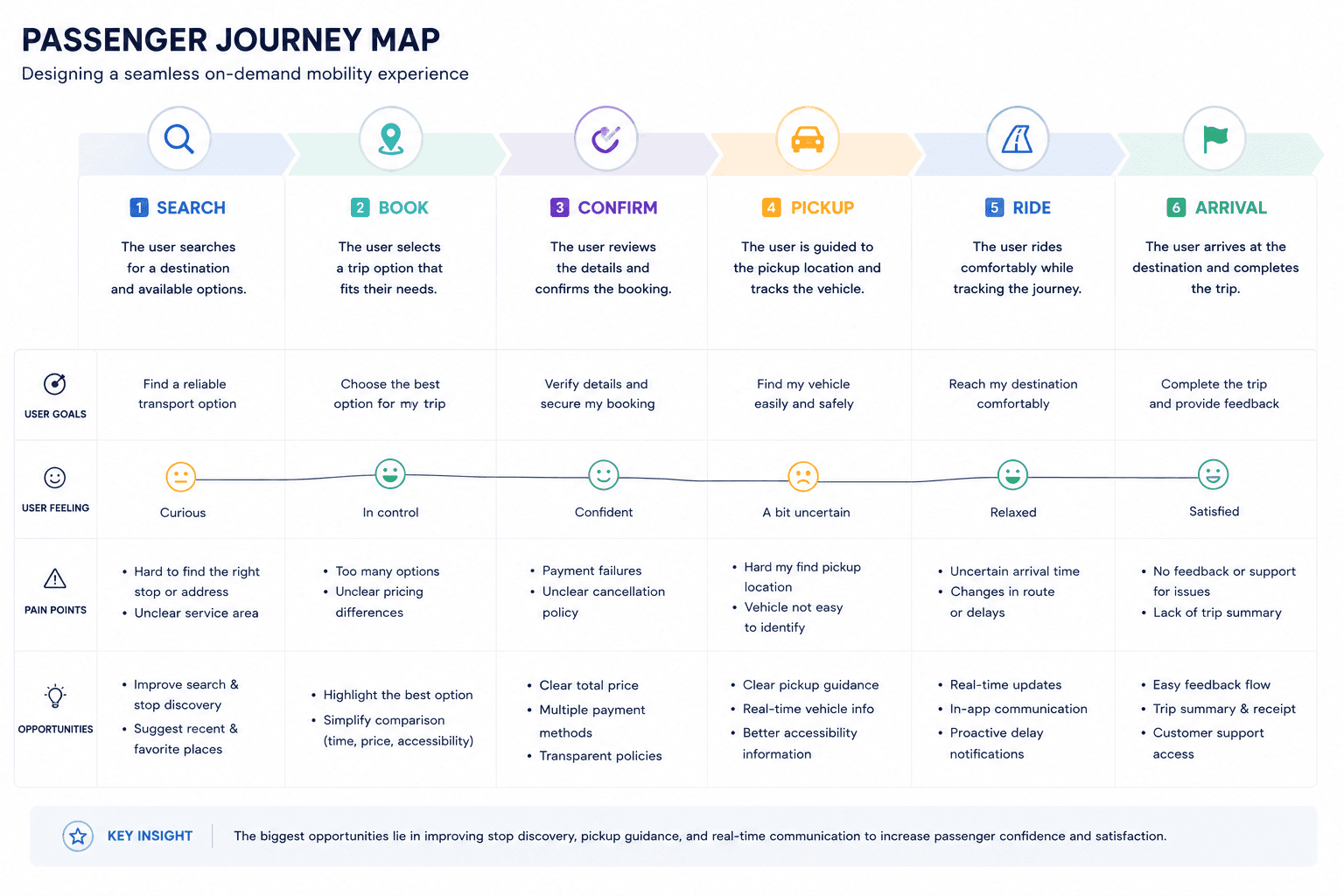
Before designing screens, we collaborated with Product Owners and Engineers to map the complete passenger journey, explore alternative flows and validate edge cases. This process helped us balance user expectations, operational constraints and technical feasibility before moving into detailed design.


Beyond the MVP
Launching the MVP was only the first step in building a complete passenger experience.
The initial release focused on validating the core journey: onboarding, booking, pickup, ride tracking and feedback. Once these foundations were in place, the product roadmap expanded to address more advanced passenger needs and operational scenarios.
Some of the opportunities explored included:
User profile management
Accessibility preferences (wheelchair-accessible vehicles, assistance needs)
Traveling with luggage
Traveling with children
Traveling with pets
Promo codes and discounts
Travel passes and subscriptions
Operator-specific services
Many of these features extended beyond the Traveler App itself and required changes across the wider mobility ecosystem, including dispatching logic, fleet configuration and orchestration rules.
This highlighted an important realization: while the MVP focused on validating the core passenger experience, building a truly inclusive and flexible mobility platform required continuous iteration across both the user experience and the underlying operational systems.
Continuous Improvement
Because mobility services operate in real-world environments, we continuously validated and improved the experience through usability testing, field observations and user feedback. Our objective was not only to evaluate the Traveler App but to assess the entire mobility ecosystem, including the Driver App, Traveler App and Orchestrator Dashboard.
To better understand operational realities and passenger expectations, we regularly organized field testing sessions with real users and operators and our also internal team. These sessions allowed us to evaluate the complete mobility experience across all touchpoints.
Launching the MVP was only the beginning of the journey.
To evaluate the experience in real-world conditions, we organized field testing sessions involving the entire mobility ecosystem, including the Traveler App, Driver App and Orchestrator Dashboard.
The goal was to validate the station-to-station experience, evaluate new features and better understand passenger expectations around booking, pickup and ride experience.
Platforms Tested
Traveler App
Driver App
Orchestrator Dashboard
The study focused on evaluating the station-to-station journey, while also gathering feedback on newly introduced features, including:
Enhanced ride rating categories
Improved ETA communication from the platform
Ride-sharing scenarios and passenger understanding
Overall booking and pickup experience.
2022
Test Field
2022
Test Field
17
participants
17
participants
77.4
SUS result
77.4
SUS result
3
products tested
3
products tested

Beyond qualitative feedback, we used the System Usability Scale (SUS) to quantify usability and compare the experience against recognized industry benchmarks. This helped us validate design decisions and prioritize future improvements based on measurable user satisfaction.Results


What We Learned
The testing sessions highlighted several recurring themes across participants.
✅ Strengths
✓ Easy booking flow
✓ Intuitive ride tracking
✓ Fast learning curve
✓ Positive perception of the overall experience
🎯 Opportunities
⚠ Pickup guidance
⚠ Vehicle identification
⚠ Ride-sharing transparency
Finding #1 — Pickup Guidance
While the SUS score helped measure overall usability, user comments provided the context behind the rating and revealed a recurring challenge around pickup guidance.
🗣️ Verbatims
"I would have liked clearer instructions about how to reach the pickup location."
"Not super clear to me if I have to walk somewhere to meet the driver."
"I did not understand what was displayed on the map, what was the walking path versus the car's path."
💡 Insight
Users were primarily focused on understanding where they needed to go to reach the virtual stop. Additional vehicle information was less important until they were close to the pickup point.
🛠 Design Decision
We simplified the pickup experience by prioritizing the route to the pickup location and reducing unnecessary map information.
The vehicle route was removed and only displayed when the vehicle was approaching. We introduced a visual route line between the passenger and the pickup point, helping users better understand where they needed to go while remaining technically feasible.


Version 2019

Version 2022
This was a good example of how field testing helped transform an identified usability issue into a prioritized product improvement.
Field testing revealed that passengers were often confused by the multiple routes displayed on the map. To reduce cognitive load, we simplified the experience by prioritizing the walking path to the pickup stop and delaying vehicle tracking information until the vehicle was close to arrival. This helped passengers focus on their immediate task: reaching the pickup location.
Finding #2 — Vehicle Identification
Passengers generally appreciated the live vehicle tracking and arrival information. However, several participants reported uncertainty when trying to identify the correct vehicle at pickup.
🗣️ Verbatims
"The live view of the car and estimated time meet all my millennial needs. However, I would have found more info about the car picking me up to be useful."
"I don't feel like I have enough information about the vehicle. I'm not familiar with car models, so a photo would help me identify it more easily."
💡 Insight
Passengers need confidence when identifying their vehicle, especially in busy pickup areas.
🛠 Design Consideration
At Bestmile, the idea of integrating vehicle photos was regularly discussed. However, supporting vehicle imagery across multiple operators introduced additional technical and operational challenges, as fleets varied significantly in terms of vehicle models, colors and available data.
For the MVP, we focused on license plate, model and vehicle color information. Vehicle photos remained a promising opportunity for future iterations and have since become a common pattern in products such as Uber and Lyft.
Iterative Design Process
Every testing cycle followed a continuous improvement approach:
Design -> Prototype -> Field Testing -> Usability Evaluation -> Insights -> Product Improvements -> Retest
This iterative process helped us continuously refine the passenger experience while ensuring alignment with operational needs and business objectives.
Impact
Field testing helped validate assumptions, uncover usability and technical issues and support prioritization discussions with Product and Engineering teams.
Several improvements, including enhanced pickup guidance and vehicle identification refinements, were directly influenced by user feedback collected during these sessions.
Most importantly, these tests reinforced a core principle of the project:
Design decisions should be driven by real user behavior, not assumptions.
Reflection
The most valuable lesson from this project was understanding how interconnected mobility products are. Every passenger interaction is influenced by decisions made across the wider ecosystem, from dispatching and fleet operations to driver workflows and accessibility requirements.
Working on the Traveler App taught me how to design for an ecosystem rather than a single product, aligning user needs, operational realities and business goals into one cohesive experience. It reinforced the value of continuous testing, cross-functional collaboration and systems thinking when designing complex mobility services.
While this case study represents only a small part of my journey at Bestmile and ZF SCALAR, it reflects the way I like to work: staying close to users, validating assumptions through research and testing, and continuously iterating to improve the experience with my team and engineer.
It also reminds me of some of the foundations we built at Bestmile, including the creation of our first Design System, which helped bring consistency across products and teams. Whether working on design systems, mobility platforms or user research, my goal has always been the same: create user-centered experiences while balancing technical, operational and business realities.
Design the TRAVELER APP at bestmile and AT SCALAR
Led the product design of the Traveler App following Bestmile's acquisition by ZF SCALAR, leveraging and evolving existing mobility capabilities to support new strategic directions and market opportunities.
Year :
2019 -2023
Industry :
Transportation
Client :
Bestmile/ZF SCALAR
Project Duration :
4 years
A white-label mobility platform designed for the future of on-demand transportation.
Following the acquisition of Bestmile by ZF, I contributed to the redesign of the Dashboard, driver app, and the Traveler App. The traveler application is a passenger-facing mobile app enabling users to book and manage on-demand transportation services.
The challenge at Bestmile and following at ZF SCALAR was to create a scalable experience that could support multiple operators, service models and operational constraints while remaining intuitive for passengers.
My role
Lead Product Designer
UX Strategy
User Research
Benchmarking
User Flows
Wireframing
Design System
Usability Testing
Stakeholder Alignment
UI Design (since 2023 with Guillaume David )
Usability Testing and SUS Evaluation
Continous improvement
The Challenge
Designing mobility experiences for multiple operators is significantly more complex than designing a traditional ride-hailing application such as Uber or Lyft.
Unlike consumer platforms that operate under a single service model, ZF SCALAR powers a wide range of transportation operators, each with its own operational rules, service areas, booking constraints, fleet configuration and passenger expectations.
Some operators offer:
Door-to-door transportation
Station-to-station services
Virtual stops
Fixed routes
On-demand transit
Hybrid mobility services
As a white-label platform, the Traveler App needed to provide a consistent and intuitive passenger experience while remaining flexible enough to support different operational models and local requirements.
The challenge was not simply to design a booking flow, but to create a scalable mobility experience capable of adapting to multiple transportation services without increasing complexity for passengers.
Every interaction had to balance passenger expectations with real-world operational constraints.
Research & Benchmarking
How might we create a familiar mobility experience while supporting the complexity of on-demand transportation across multiple operators and service models?
Designing a mobility platform is not as simple as replicating the experience of a traditional ride-hailing application.
Unlike Uber or Lyft, ZF SCALAR powers multiple transportation operators, each with different operational rules, service areas, booking constraints and accessibility requirements. The challenge was to create a passenger experience that felt familiar and intuitive while remaining flexible enough to support a wide range of transportation services.
To better understand passenger expectations and industry standards, we started by benchmarking mobility leaders and direct competitors.
Mobility Platforms Analyzed
Ride-Hailing Leaders
We analyzed these products because they have established interaction patterns that millions of passengers already understand and trust.
Direct Competitors
These platforms provided valuable insights into demand-responsive transportation, virtual stops, shared mobility and operator-specific constraints.
Autonomous Mobility
Waymo helped us understand how autonomous transportation experiences build trust, communicate vehicle status and guide passengers through unfamiliar interactions.
Benchmarking was an ongoing activity throughout the project. Depending on the feature or user journey being designed, we analyzed additional transportation and mobility platforms such as CFF, SNCF, IOKI and other regional operators to better understand user expectations and industry best practices.
Defining the MVP
To validate the core passenger experience quickly, we focused on the most critical journey steps and designed a first MVP around them.
Passenger Journey
Onboarding
Login & Registration
Search Destination
Book a Ride
Booking Confirmation
Cancel a Ride
Navigate to Pickup / Stop Location
Ride Experience (On the Way to Destination)
Arrival, trip Feedback
Ride history
For each step, we analyzed existing industry patterns, identified best practices and evaluated how they could be adapted to the realities of on-demand public transportation and our own internal constraint.
The goal was not to copy competitors, but to leverage familiar interaction patterns while accommodating operator constraints, accessibility requirements and the flexibility needed for a white-label mobility platform.
Before designing screens, we collaborated with Product Owners and Engineers to map the complete passenger journey, explore alternative flows and validate edge cases. This process helped us balance user expectations, operational constraints and technical feasibility before moving into detailed design.
Beyond the MVP
Launching the MVP was only the first step in building a complete passenger experience.
The initial release focused on validating the core journey: onboarding, booking, pickup, ride tracking and feedback. Once these foundations were in place, the product roadmap expanded to address more advanced passenger needs and operational scenarios.
Some of the opportunities explored included:
User profile management
Accessibility preferences (wheelchair-accessible vehicles, assistance needs)
Traveling with luggage
Traveling with children
Traveling with pets
Promo codes and discounts
Travel passes and subscriptions
Operator-specific services
Many of these features extended beyond the Traveler App itself and required changes across the wider mobility ecosystem, including dispatching logic, fleet configuration and orchestration rules.
This highlighted an important realization: while the MVP focused on validating the core passenger experience, building a truly inclusive and flexible mobility platform required continuous iteration across both the user experience and the underlying operational systems.
Continuous Improvement
Because mobility services operate in real-world environments, we continuously validated and improved the experience through usability testing, field observations and user feedback. Our objective was not only to evaluate the Traveler App but to assess the entire mobility ecosystem, including the Driver App, Traveler App and Orchestrator Dashboard.
To better understand operational realities and passenger expectations, we regularly organized field testing sessions with real users and operators and our also internal team. These sessions allowed us to evaluate the complete mobility experience across all touchpoints.
Launching the MVP was only the beginning of the journey.
To evaluate the experience in real-world conditions, we organized field testing sessions involving the entire mobility ecosystem, including the Traveler App, Driver App and Orchestrator Dashboard.
The goal was to validate the station-to-station experience, evaluate new features and better understand passenger expectations around booking, pickup and ride experience.
Platforms Tested
Traveler App
Driver App
Orchestrator Dashboard
The study focused on evaluating the station-to-station journey, while also gathering feedback on newly introduced features, including:
Enhanced ride rating categories
Improved ETA communication from the platform
Ride-sharing scenarios and passenger understanding
Overall booking and pickup experience.
2022
Test Field
2022
Test Field
17
participants
17
participants
77.4
SUS result
77.4
SUS result
3
products tested
3
products tested
Beyond qualitative feedback, we used the System Usability Scale (SUS) to quantify usability and compare the experience against recognized industry benchmarks. This helped us validate design decisions and prioritize future improvements based on measurable user satisfaction.Results
What We Learned
The testing sessions highlighted several recurring themes across participants.
✅ Strengths
✓ Easy booking flow
✓ Intuitive ride tracking
✓ Fast learning curve
✓ Positive perception of the overall experience
🎯 Opportunities
⚠ Pickup guidance
⚠ Vehicle identification
⚠ Ride-sharing transparency
Finding #1 — Pickup Guidance
While the SUS score helped measure overall usability, user comments provided the context behind the rating and revealed a recurring challenge around pickup guidance.
🗣️ Verbatims
"I would have liked clearer instructions about how to reach the pickup location."
"Not super clear to me if I have to walk somewhere to meet the driver."
"I did not understand what was displayed on the map, what was the walking path versus the car's path."
💡 Insight
Users were primarily focused on understanding where they needed to go to reach the virtual stop. Additional vehicle information was less important until they were close to the pickup point.
🛠 Design Decision
We simplified the pickup experience by prioritizing the route to the pickup location and reducing unnecessary map information.
The vehicle route was removed and only displayed when the vehicle was approaching. We introduced a visual route line between the passenger and the pickup point, helping users better understand where they needed to go while remaining technically feasible.
Version 2019
Version 2022
This was a good example of how field testing helped transform an identified usability issue into a prioritized product improvement.
Field testing revealed that passengers were often confused by the multiple routes displayed on the map. To reduce cognitive load, we simplified the experience by prioritizing the walking path to the pickup stop and delaying vehicle tracking information until the vehicle was close to arrival. This helped passengers focus on their immediate task: reaching the pickup location.
Finding #2 — Vehicle Identification
Passengers generally appreciated the live vehicle tracking and arrival information. However, several participants reported uncertainty when trying to identify the correct vehicle at pickup.
🗣️ Verbatims
"The live view of the car and estimated time meet all my millennial needs. However, I would have found more info about the car picking me up to be useful."
"I don't feel like I have enough information about the vehicle. I'm not familiar with car models, so a photo would help me identify it more easily."
💡 Insight
Passengers need confidence when identifying their vehicle, especially in busy pickup areas.
🛠 Design Consideration
At Bestmile, the idea of integrating vehicle photos was regularly discussed. However, supporting vehicle imagery across multiple operators introduced additional technical and operational challenges, as fleets varied significantly in terms of vehicle models, colors and available data.
For the MVP, we focused on license plate, model and vehicle color information. Vehicle photos remained a promising opportunity for future iterations and have since become a common pattern in products such as Uber and Lyft.
Iterative Design Process
Every testing cycle followed a continuous improvement approach:
Design -> Prototype -> Field Testing -> Usability Evaluation -> Insights -> Product Improvements -> Retest
This iterative process helped us continuously refine the passenger experience while ensuring alignment with operational needs and business objectives.
Impact
Field testing helped validate assumptions, uncover usability and technical issues and support prioritization discussions with Product and Engineering teams.
Several improvements, including enhanced pickup guidance and vehicle identification refinements, were directly influenced by user feedback collected during these sessions.
Most importantly, these tests reinforced a core principle of the project:
Design decisions should be driven by real user behavior, not assumptions.
Reflection
The most valuable lesson from this project was understanding how interconnected mobility products are. Every passenger interaction is influenced by decisions made across the wider ecosystem, from dispatching and fleet operations to driver workflows and accessibility requirements.
Working on the Traveler App taught me how to design for an ecosystem rather than a single product, aligning user needs, operational realities and business goals into one cohesive experience. It reinforced the value of continuous testing, cross-functional collaboration and systems thinking when designing complex mobility services.
While this case study represents only a small part of my journey at Bestmile and ZF SCALAR, it reflects the way I like to work: staying close to users, validating assumptions through research and testing, and continuously iterating to improve the experience with my team and engineer.
It also reminds me of some of the foundations we built at Bestmile, including the creation of our first Design System, which helped bring consistency across products and teams. Whether working on design systems, mobility platforms or user research, my goal has always been the same: create user-centered experiences while balancing technical, operational and business realities.
Design the TRAVELER APP at bestmile and AT SCALAR
Led the product design of the Traveler App following Bestmile's acquisition by ZF SCALAR, leveraging and evolving existing mobility capabilities to support new strategic directions and market opportunities.
Year :
2019 -2023
Industry :
Transportation
Client :
Bestmile/ZF SCALAR
Project Duration :
4 years
A white-label mobility platform designed for the future of on-demand transportation.
Following the acquisition of Bestmile by ZF, I contributed to the redesign of the Dashboard, driver app, and the Traveler App. The traveler application is a passenger-facing mobile app enabling users to book and manage on-demand transportation services.
The challenge at Bestmile and following at ZF SCALAR was to create a scalable experience that could support multiple operators, service models and operational constraints while remaining intuitive for passengers.
My role
Lead Product Designer
UX Strategy
User Research
Benchmarking
User Flows
Wireframing
Design System
Usability Testing
Stakeholder Alignment
UI Design (since 2023 with Guillaume David )
Usability Testing and SUS Evaluation
Continous improvement
The Challenge
Designing mobility experiences for multiple operators is significantly more complex than designing a traditional ride-hailing application such as Uber or Lyft.
Unlike consumer platforms that operate under a single service model, ZF SCALAR powers a wide range of transportation operators, each with its own operational rules, service areas, booking constraints, fleet configuration and passenger expectations.
Some operators offer:
Door-to-door transportation
Station-to-station services
Virtual stops
Fixed routes
On-demand transit
Hybrid mobility services
As a white-label platform, the Traveler App needed to provide a consistent and intuitive passenger experience while remaining flexible enough to support different operational models and local requirements.
The challenge was not simply to design a booking flow, but to create a scalable mobility experience capable of adapting to multiple transportation services without increasing complexity for passengers.
Every interaction had to balance passenger expectations with real-world operational constraints.
Research & Benchmarking
How might we create a familiar mobility experience while supporting the complexity of on-demand transportation across multiple operators and service models?
Designing a mobility platform is not as simple as replicating the experience of a traditional ride-hailing application.
Unlike Uber or Lyft, ZF SCALAR powers multiple transportation operators, each with different operational rules, service areas, booking constraints and accessibility requirements. The challenge was to create a passenger experience that felt familiar and intuitive while remaining flexible enough to support a wide range of transportation services.
To better understand passenger expectations and industry standards, we started by benchmarking mobility leaders and direct competitors.
Mobility Platforms Analyzed
Ride-Hailing Leaders
We analyzed these products because they have established interaction patterns that millions of passengers already understand and trust.
Direct Competitors
These platforms provided valuable insights into demand-responsive transportation, virtual stops, shared mobility and operator-specific constraints.
Autonomous Mobility
Waymo helped us understand how autonomous transportation experiences build trust, communicate vehicle status and guide passengers through unfamiliar interactions.
Benchmarking was an ongoing activity throughout the project. Depending on the feature or user journey being designed, we analyzed additional transportation and mobility platforms such as CFF, SNCF, IOKI and other regional operators to better understand user expectations and industry best practices.
Defining the MVP
To validate the core passenger experience quickly, we focused on the most critical journey steps and designed a first MVP around them.
Passenger Journey
Onboarding
Login & Registration
Search Destination
Book a Ride
Booking Confirmation
Cancel a Ride
Navigate to Pickup / Stop Location
Ride Experience (On the Way to Destination)
Arrival, trip Feedback
Ride history
For each step, we analyzed existing industry patterns, identified best practices and evaluated how they could be adapted to the realities of on-demand public transportation and our own internal constraint.
The goal was not to copy competitors, but to leverage familiar interaction patterns while accommodating operator constraints, accessibility requirements and the flexibility needed for a white-label mobility platform.
Before designing screens, we collaborated with Product Owners and Engineers to map the complete passenger journey, explore alternative flows and validate edge cases. This process helped us balance user expectations, operational constraints and technical feasibility before moving into detailed design.
Beyond the MVP
Launching the MVP was only the first step in building a complete passenger experience.
The initial release focused on validating the core journey: onboarding, booking, pickup, ride tracking and feedback. Once these foundations were in place, the product roadmap expanded to address more advanced passenger needs and operational scenarios.
Some of the opportunities explored included:
User profile management
Accessibility preferences (wheelchair-accessible vehicles, assistance needs)
Traveling with luggage
Traveling with children
Traveling with pets
Promo codes and discounts
Travel passes and subscriptions
Operator-specific services
Many of these features extended beyond the Traveler App itself and required changes across the wider mobility ecosystem, including dispatching logic, fleet configuration and orchestration rules.
This highlighted an important realization: while the MVP focused on validating the core passenger experience, building a truly inclusive and flexible mobility platform required continuous iteration across both the user experience and the underlying operational systems.
Continuous Improvement
Because mobility services operate in real-world environments, we continuously validated and improved the experience through usability testing, field observations and user feedback. Our objective was not only to evaluate the Traveler App but to assess the entire mobility ecosystem, including the Driver App, Traveler App and Orchestrator Dashboard.
To better understand operational realities and passenger expectations, we regularly organized field testing sessions with real users and operators and our also internal team. These sessions allowed us to evaluate the complete mobility experience across all touchpoints.
Launching the MVP was only the beginning of the journey.
To evaluate the experience in real-world conditions, we organized field testing sessions involving the entire mobility ecosystem, including the Traveler App, Driver App and Orchestrator Dashboard.
The goal was to validate the station-to-station experience, evaluate new features and better understand passenger expectations around booking, pickup and ride experience.
Platforms Tested
Traveler App
Driver App
Orchestrator Dashboard
The study focused on evaluating the station-to-station journey, while also gathering feedback on newly introduced features, including:
Enhanced ride rating categories
Improved ETA communication from the platform
Ride-sharing scenarios and passenger understanding
Overall booking and pickup experience.
2022
Test Field
2022
Test Field
17
participants
17
participants
77.4
SUS result
77.4
SUS result
3
products tested
3
products tested
Beyond qualitative feedback, we used the System Usability Scale (SUS) to quantify usability and compare the experience against recognized industry benchmarks. This helped us validate design decisions and prioritize future improvements based on measurable user satisfaction.Results
What We Learned
The testing sessions highlighted several recurring themes across participants.
✅ Strengths
✓ Easy booking flow
✓ Intuitive ride tracking
✓ Fast learning curve
✓ Positive perception of the overall experience
🎯 Opportunities
⚠ Pickup guidance
⚠ Vehicle identification
⚠ Ride-sharing transparency
Finding #1 — Pickup Guidance
While the SUS score helped measure overall usability, user comments provided the context behind the rating and revealed a recurring challenge around pickup guidance.
🗣️ Verbatims
"I would have liked clearer instructions about how to reach the pickup location."
"Not super clear to me if I have to walk somewhere to meet the driver."
"I did not understand what was displayed on the map, what was the walking path versus the car's path."
💡 Insight
Users were primarily focused on understanding where they needed to go to reach the virtual stop. Additional vehicle information was less important until they were close to the pickup point.
🛠 Design Decision
We simplified the pickup experience by prioritizing the route to the pickup location and reducing unnecessary map information.
The vehicle route was removed and only displayed when the vehicle was approaching. We introduced a visual route line between the passenger and the pickup point, helping users better understand where they needed to go while remaining technically feasible.
Version 2019
Version 2022
This was a good example of how field testing helped transform an identified usability issue into a prioritized product improvement.
Field testing revealed that passengers were often confused by the multiple routes displayed on the map. To reduce cognitive load, we simplified the experience by prioritizing the walking path to the pickup stop and delaying vehicle tracking information until the vehicle was close to arrival. This helped passengers focus on their immediate task: reaching the pickup location.
Finding #2 — Vehicle Identification
Passengers generally appreciated the live vehicle tracking and arrival information. However, several participants reported uncertainty when trying to identify the correct vehicle at pickup.
🗣️ Verbatims
"The live view of the car and estimated time meet all my millennial needs. However, I would have found more info about the car picking me up to be useful."
"I don't feel like I have enough information about the vehicle. I'm not familiar with car models, so a photo would help me identify it more easily."
💡 Insight
Passengers need confidence when identifying their vehicle, especially in busy pickup areas.
🛠 Design Consideration
At Bestmile, the idea of integrating vehicle photos was regularly discussed. However, supporting vehicle imagery across multiple operators introduced additional technical and operational challenges, as fleets varied significantly in terms of vehicle models, colors and available data.
For the MVP, we focused on license plate, model and vehicle color information. Vehicle photos remained a promising opportunity for future iterations and have since become a common pattern in products such as Uber and Lyft.
Iterative Design Process
Every testing cycle followed a continuous improvement approach:
Design -> Prototype -> Field Testing -> Usability Evaluation -> Insights -> Product Improvements -> Retest
This iterative process helped us continuously refine the passenger experience while ensuring alignment with operational needs and business objectives.
Impact
Field testing helped validate assumptions, uncover usability and technical issues and support prioritization discussions with Product and Engineering teams.
Several improvements, including enhanced pickup guidance and vehicle identification refinements, were directly influenced by user feedback collected during these sessions.
Most importantly, these tests reinforced a core principle of the project:
Design decisions should be driven by real user behavior, not assumptions.
Reflection
The most valuable lesson from this project was understanding how interconnected mobility products are. Every passenger interaction is influenced by decisions made across the wider ecosystem, from dispatching and fleet operations to driver workflows and accessibility requirements.
Working on the Traveler App taught me how to design for an ecosystem rather than a single product, aligning user needs, operational realities and business goals into one cohesive experience. It reinforced the value of continuous testing, cross-functional collaboration and systems thinking when designing complex mobility services.
While this case study represents only a small part of my journey at Bestmile and ZF SCALAR, it reflects the way I like to work: staying close to users, validating assumptions through research and testing, and continuously iterating to improve the experience with my team and engineer.
It also reminds me of some of the foundations we built at Bestmile, including the creation of our first Design System, which helped bring consistency across products and teams. Whether working on design systems, mobility platforms or user research, my goal has always been the same: create user-centered experiences while balancing technical, operational and business realities.